
NASA L'SPACE Mission Concept Academy
Team ODIN: Mars Rover Mission Design
"Obtain Data on Ice and Neutrons"
Computer Engineer | Command & Data Handling Subsystem
May 2025 - August 2025 | 15-20 hrs/week

About NASA L'SPACE
NASA's Lucy Student Pipeline Accelerator and Competency Enabler (L'SPACE) is a prestigious national workforce development program designed to prepare the next generation of space professionals. Through authentic mission concept development, participants gain hands-on experience following NASA's mission lifecycle from concept through preliminary design review.
The Mission Concept Academy challenges interdisciplinary teams to develop comprehensive mission proposals addressing real scientific questions. Over 12 intensive weeks, students master systems engineering processes, technical documentation, project management, and team collaboration—mirroring the workflows used by NASA and aerospace industry professionals.
Under the mentorship of Owen Krumm, a NASA professional, Team ODIN delivered an exceptional performance, earning a High Intermediate overall rating with the Command & Data Handling subsystem achieving PROFESSIONAL status—the highest technical rating possible. Our PDR presentation left NASA reviewers with no questions, having comprehensively addressed every aspect of the mission design.
Team Members
Program Weeks
Mission Budget
CDH Rating
Mission ODIN: Mars Radiation & Ice Investigation
🎯 Mission Objectives
- Human Exploration: Evaluate radiation effects on Mars' surface impacting plants, humans, and organisms
- Science: Understand atmospheric and surface processes affecting Martian ice chemistry
- Geology: Assess how internal heat influences Martian subsurface ice distribution
📍 Landing Site
Arcadia Planitia
- Mid-northern latitude region
- Extensive subsurface ice deposits
- Scientifically rich radiation environment
- Accessible terrain for rover operations
🚀 Mission Architecture
- System: Mobile rover platform
- Duration: 1 Martian year surface operations
- Instruments: 4 scientific payloads
- Communication: UHF relay via orbiters
💰 Mission Budget
Total: $418,967,997
- Direct Costs: $351.5M
- Indirect Costs: $67.5M
- CDH Subsystem: $45M
- 30-month build-to-launch
My Role: CDH Computer Engineer & Programmatic Specialist
As part of the 2-person Command & Data Handling (CDH) team, I served as the computer engineer with a focus on programmatic integration, earning our subsystem a PROFESSIONAL rating from NASA reviewers. My responsibilities spanned technical systems engineering, 3D modeling, documentation, and cross-functional coordination to ensure the CDH subsystem served as the "brain" of the ODIN rover.
CDH Systems Architecture & Design
Architected the spacecraft's central nervous system, defining requirements for the onboard computer (DDC SCS3740), data storage (RH3440 Solid-State Recorder), and communications chain (C/TT-505 UHF Transceiver + RUHF Antenna). Designed data flow between all subsystems ensuring robust fault management and mission reliability under Mars' harsh radiation environment.
Researched and compared radiation-hardened processors and memory components, ultimately recommending a modular CDH architecture providing redundancy and scalability aligned with NASA standards. Specified 100 krad(Si) radiation tolerance, –55°C to +85°C operating range, and hardware EDAC (Error Detection and Correction) for critical systems.
Programmatic Leadership & Documentation
Led programmatic aspects of the CDH subsystem, managing schedules using Gantt charts, tracking deliverables, and coordinating cross-team dependencies. Wrote the comprehensive CDH section of the Preliminary Design Review (PDR), detailing system architecture, component selection rationale, risk assessments, and mitigation strategies including watchdog timers and error detection protocols.
Participated in weekly cross-functional meetings ensuring CDH solutions aligned with evolving mission objectives from Power, Communications, Payload, Mechanical, and Thermal teams. Maintained Interface Control Documents (ICDs) specifying data interfaces, timing constraints, and communication protocols between all rover subsystems.
3D Modeling & Hardware Integration
Utilized Siemens NX for comprehensive 3D CAD modeling of CDH components and their integration within the rover chassis. Created detailed models ensuring proper fit, thermal management, and cable routing for electronics vault housing the flight computer, data recorder, and communication systems.
Designed and modeled the rover's drill system for subsurface ice sampling, coordinating mechanical interfaces with the Thermal and Evolved-Gas Analyzer (TEGA) payload. Ensured drill placement, actuation mechanisms, and sample transfer paths were optimized for mission science objectives while maintaining structural integrity under Martian conditions.
Systems Engineering & Requirements
Applied NASA systems engineering methodology throughout the mission lifecycle, from concept formulation through PDR. Developed and managed CDH subsystem requirements derived from mission science objectives, environmental constraints, programmatic schedules, and cost targets, ensuring full traceability and compliance.
Conducted trade studies evaluating technology options across power consumption, mass, volume, radiation tolerance, and Technology Readiness Level (TRL). Performed risk analysis identifying single-point failures and designing redundancy strategies, ultimately achieving TRL 5 subsystem maturity required for PDR gate.
Command & Data Handling Subsystem: Technical Deep Dive
The CDH subsystem orchestrates every information pathway on the ODIN rover, serving as the central nervous system that receives commands, schedules payloads, stores science data, and coordinates telemetry transmission to Earth. Operating in Arcadia Planitia's harsh environment—with 200 K temperature swings, pervasive dust, and continuous ionizing radiation—every component required radiation tolerance, low power consumption, and mechanical hardening.
System Architecture
🖥️ Onboard Computer: DDC SCS3740
TRL: 5 | Mass: 0.55 kg | Power: 12 W
- Processor: Quad-core LEON-4 (1700 DMIPS/core)
- Radiation Hardness: 100 krad(Si) TID, SEU-protected
- Interfaces: SpaceWire, UART/SPI buses
- Memory: Hardware EDAC in SDRAM & NOR flash
- Operating System: RTEMS real-time OS
- Heritage: ESA PROBA-3 mission
💾 Data Storage: RH3440 Solid-State Recorder
TRL: 5 | Mass: 0.62 kg | Power: 14 W
- Capacity: 440 GB non-volatile NAND
- Error Correction: Reed-Solomon scrubbing
- Interface Speed: 100 Mbps SpaceWire
- Throughput: 60 Mbps sustained
- Scrubbing: 30-second SEU correction cycles
- Redundancy: Fault-tolerant distributed storage
📡 UHF Transceiver: L3Harris C/TT-505
TRL: 5 | Mass: 0.17 kg | Power: 60 W (TX) / 6 W (RX)
- Frequency: 435-455 MHz Mars Relay band
- Data Rates: 8-256 kbps downlink, 2 kbps uplink
- Transmit Duration: 5-minute daily downlinks
- Modulation: Digital radio with adaptive coding
- Compatibility: Mars Relay Network interoperable
📶 Antenna: RUHF Turnstile
TRL: 6 | Mass: 0.10 kg | Power: Passive
- Design: Fixed dual-dipole right-circular polarized
- Gain: ≥4.1 dBi across hemisphere
- Link Margin: ≥15 dB to orbiters at 30° elevation
- Advantage: No deployment risk, omnidirectional
- Heritage: MSL Curiosity rover (TRL 9)
📷 Nav/Terrain Camera: NaTeCam
TRL: 6 | Mass: 0.70 kg | Power: 1.8 W
- Sensor: 4K×3K Si/HgCdTe hybrid (12-bit)
- Frame Rate: 5 fps global shutter
- Purpose: Stereo drive planning, dust monitoring
- Coating: Sol-gel AR prevents dust accumulation
- Heritage: Derived from ESA Rosalind Franklin ECAM-C
✨ Flight Software Architecture
TRL: 5 | Development: RTEMS-based 3-layer stack
- Layer 1: RTOS services, drivers, board support
- Layer 2: Subsystem managers (CDH, EPS, Thermal, Mobility)
- Layer 3: Payload applications (TEGA, LIBS, NaTeCam)
- Autonomy: 8-hour comm blackout operation
- Recovery: Rapid SEU fault recovery
- Testing: System integration testbed validation
Subsystem Summary
| Component | Mass (kg) | Volume (m³) | Power (W) | TRL |
|---|---|---|---|---|
| DDC SCS3740 SBC | 0.55 | 0.0004 | 12 | 5 |
| RH3440 Solid-State Recorder | 0.62 | 0.0004 | 14 | 5 |
| L3 Harris C/TT-505 | 0.17 | 0.000585 | 60 (TX) / 6 (RX) | 5 |
| RUHF Turnstile Antenna | 0.10 | 0.00410 | Passive | 6 |
| NaTeCam | 0.70 | 0.00924 | 1.8 | 6 |
| TOTAL | 2.14 | 0.014725 | 87.8 | 5 |
Overall Rover Design & Integration
Vehicle Specifications
Stowed Configuration
2.282 × 2.1 × 1.798 m³
Deployed Configuration
3.52 × 2.9 × 2.09 m³
Total Mass
172.084 kg
Total Power
340.05 W max
Total Volume
9.70 m³
System TRL
5 (PDR ready)
Rover Subsystems Integration
🔬 Payload (25.15 kg | 73.55 W)
- TEGA: Thermal & Evolved-Gas Analyzer
- Liulin-MO: Radiation Dosimeter
- LIBS: Laser Induced Breakdown Spectrometer
- Heat Flow Probe: Subsurface thermal
⚙️ Mechanical (101.23 kg | 130.20 W)
- Aluminum 6061-T6 chassis
- 6× BLDC motors + wheels
- Robotic arm + LIBS assembly
- Drill system (designed by Brian)
🧠 CDH (3.97 kg | 87.80 W)
- Flight computer & data storage
- UHF communications system
- Navigation camera
- Flight software (RTEMS)
⚡ Power (30.14 kg | 8.50 W)
- Roll-out solar arrays
- Rechargeable batteries
- MPPT & battery management
- Power conditioning & distribution
🌡️ Thermal (11.60 kg | 40.00 W)
- Multi-layer insulation (MLI)
- Electrical heaters
- Radiators & heat pipes
- Thermal control unit
Drill System Design
Designed and modeled the rover's subsurface drill system in Siemens NX, responsible for extracting ice samples from up to 2 meters depth. The drill interfaces with the TEGA (Thermal and Evolved-Gas Analyzer) payload, delivering samples for chemical composition analysis.
Key Design Features:
- ✅ Percussion drilling mechanism for Martian regolith penetration
- ✅ Sample capture and transfer system to TEGA oven
- ✅ Thermal isolation preventing sample contamination
- ✅ Power-efficient actuation within 80 W budget
- ✅ Dust-resistant seals for Mars environment
- ✅ Heritage design inspired by ExoMars Rosalind Franklin
Programmatic Leadership & Systems Engineering
Requirements Engineering
Developed and managed comprehensive CDH subsystem requirements derived from mission science objectives, environmental envelopes, programmatic constraints, and cost targets. Maintained full traceability matrices ensuring every requirement flowed from top-level mission needs through implementation details.
Applied NASA systems engineering principles including requirements decomposition, interface definition, and verification planning. Participated in formal Systems Requirements Review (SRR) and Preliminary Design Review (PDR) milestones.
Risk Management
Identified and assessed CDH subsystem risks including single-point failures, radiation-induced upsets, thermal cycling damage, and communication link degradation. Developed comprehensive risk mitigation strategies such as hardware redundancy, error detection/correction, and autonomous fault recovery.
Maintained active risk register with probability/consequence matrices, tracking mitigation actions and residual risk levels. Addressed concerns raised during NASA mentor reviews, incorporating feedback into revised risk posture.
Schedule Management
Managed CDH sub-team schedule using Gantt charts and integrated master schedules, tracking progress against 30-month build-to-launch timeline. Coordinated procurement lead times for long-pole items like radiation-hardened FPGAs (12-month lead) ensuring critical path protection.
Participated in weekly cross-functional team meetings synchronizing CDH deliverables with Mechanical, Power, Thermal, and Payload teams. Identified schedule risks early, implementing mitigation strategies maintaining programmatic margin.
Technical Documentation
Authored the comprehensive CDH section of the Preliminary Design Review (PDR) document, detailing system architecture, component selection rationale, interface specifications, verification plans, and risk assessments. Documentation followed NASA technical writing standards ensuring clarity and completeness.
Created supporting documentation including Interface Control Documents (ICDs), block diagrams, data flow charts, and trade study reports. Incorporated peer review feedback from team members and NASA mentor, refining technical communication skills.
Cross-Functional Collaboration
Collaborated with Power team defining electrical interfaces, voltage requirements, and power budgets. Worked with Communications team ensuring RF compatibility and link margin analysis. Coordinated with Payload team specifying data rates, timing constraints, and command sequences.
Participated in system-level trade studies balancing CDH capabilities against mass, power, and cost constraints. Presented CDH architecture to entire 15-person team, incorporating feedback from multiple engineering disciplines.
Verification & Validation Planning
Developed comprehensive CDH verification strategy using test, analysis, inspection, and demonstration methods per NASA Systems Engineering Handbook guidance. Defined acceptance criteria for every requirement ensuring objective evidence of compliance.
Specified environmental qualification tests including thermal-vacuum cycling (–60°C to +90°C), vibration testing, and radiation exposure. Planned integration testing validating data flow, command responsiveness, and fault recovery under flight-like conditions.
Achievement Highlights
PROFESSIONAL Rating
CDH subsystem earned PROFESSIONAL rating from NASA reviewers—the highest technical assessment possible, recognizing exceptional depth, completeness, and adherence to aerospace standards.
Flawless PDR Presentation
Team ODIN's PDR presentation left NASA reviewers with zero questions—an extraordinary achievement indicating comprehensive coverage of all mission aspects, technical rigor, and clear communication.
High Intermediate Overall
Team achieved High Intermediate overall rating across all subsystems, demonstrating strong systems engineering, technical depth, and programmatic planning meeting NASA expectations.
$419M Mission Design
Contributed to comprehensive $418,967,997 mission concept including detailed cost estimates, procurement plans, and schedule spanning 30-month build-to-launch timeline.
Radiation Science Focus
Personally proud of mission's radiation investigation objectives, designing CDH systems capable of operating in Mars' harsh radiation environment while supporting continuous dosimetry measurements.
7 Skill Badges Earned
Successfully completed all program requirements earning badges in Teaming, Requirements, Risk Management, Mission Management, Systems Engineering, Heat Transfer, and Thermal NX CAD.
Official NASA L'SPACE Certificate
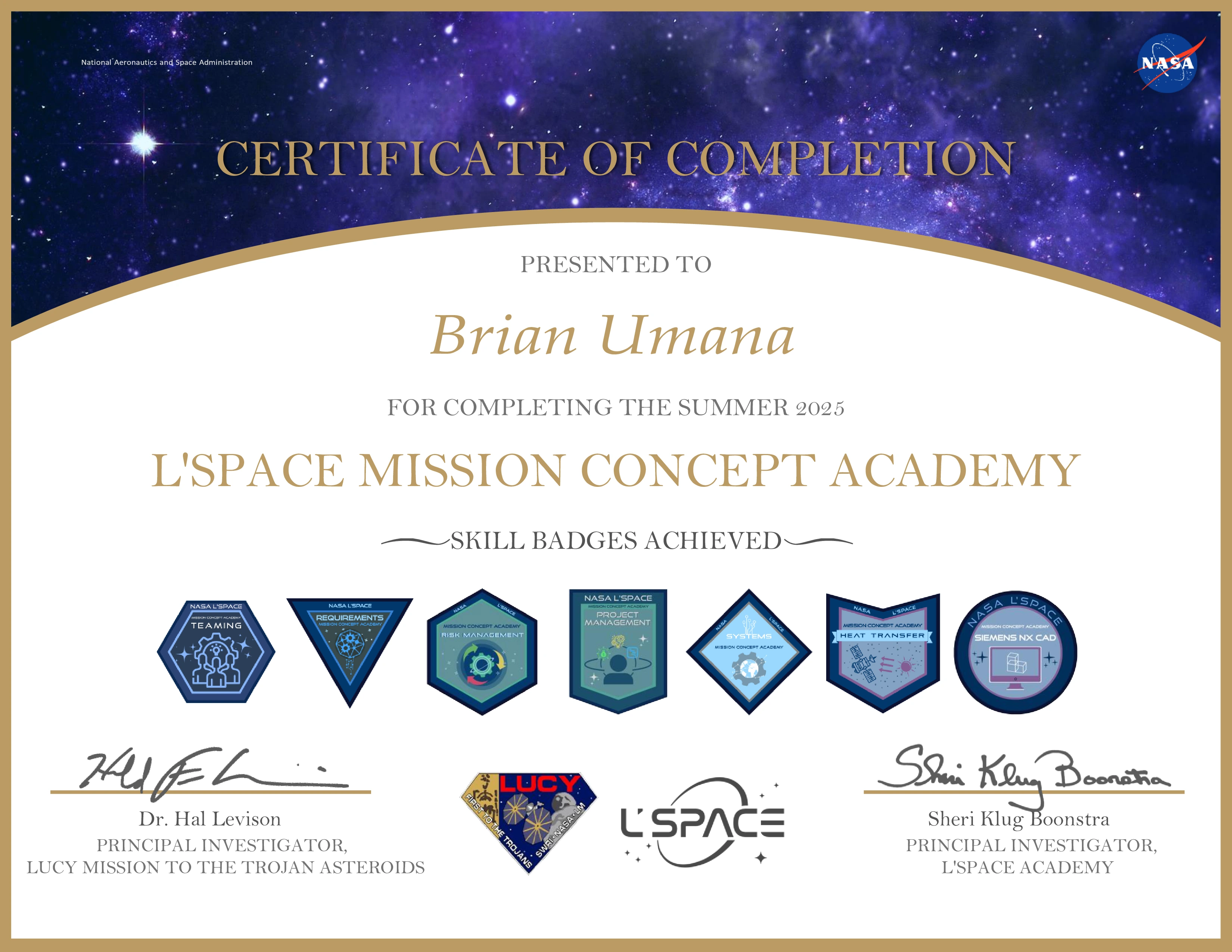
Certificate of Completion
Presented to Brian Umana
For Completing the Summer 2025
L'SPACE MISSION CONCEPT ACADEMY
Skill Badges Achieved:
NASA L'SPACE Teaming
NASA L'SPACE Requirements
NASA L'SPACE Risk Management
NASA L'SPACE Mission Management
NASA L'SPACE Systems Engineering
NASA L'SPACE Heat Transfer
NASA L'SPACE Thermal NX CAD
Dr. Hal Levison
Principal Investigator, Lucy Mission to the Trojan Asteroids
Sheri Klug Boonstra
Principal Investigator, L'SPACE Academy
Skills Developed & Professional Impact
🚀 Spacecraft Systems Engineering
Gained comprehensive understanding of spacecraft subsystem design following NASA mission lifecycle from concept through PDR. Mastered systems engineering processes including requirements decomposition, interface definition, trade studies, risk management, and verification planning—directly applicable to aerospace industry careers.
💻 Command & Data Handling Expertise
Developed specialized knowledge in radiation-hardened computing systems, data storage architectures, spacecraft communications, and fault-tolerant software design. Researched cutting-edge technology including LEON-4 processors, NAND-based recorders, UHF relay systems, and RTEMS real-time operating systems.
🎯 Technical Leadership & Communication
Led CDH subsystem to PROFESSIONAL rating through meticulous documentation, clear technical communication, and cross-functional collaboration. Authored comprehensive PDR sections, presented to NASA reviewers, and incorporated professional feedback—preparing for leadership roles in aerospace engineering.
Technical Skills Portfolio
NASA Mentorship & Program Structure
🌟 NASA Mentor: Owen Krumm
Under the expert guidance of Owen Krumm, a NASA professional, Team ODIN received invaluable insights into aerospace industry practices, technical standards, and mission design methodologies. Weekly mentorship sessions provided real-time feedback on subsystem designs, documentation quality, and presentation strategies—directly contributing to the team's exceptional performance and PROFESSIONAL CDH rating.
12-Week Program Structure
Concept Development
Mission objectives definition, science requirements, initial architecture concepts, team formation and role assignment
Systems Design
Subsystem architecture development, component selection, trade studies, interface definitions, SRR preparation
Detailed Design
CAD modeling, verification planning, risk assessment, cost estimation, schedule development
PDR & Delivery
Comprehensive documentation, presentation preparation, NASA review, feedback incorporation, final deliverables
Key Takeaways & Future Impact
"The L'SPACE Mission Concept Academy provided an unparalleled opportunity to experience authentic NASA mission development processes. Leading the CDH subsystem to a PROFESSIONAL rating validated my technical capabilities and passion for spacecraft systems engineering. This experience solidified my career trajectory toward aerospace engineering, where I aim to contribute to future Mars exploration missions and advance humanity's presence beyond Earth."
Career Implications
💼 Industry Readiness
Demonstrated proficiency in NASA standards, aerospace documentation, and systems engineering processes directly applicable to industry positions at NASA, SpaceX, Blue Origin, Lockheed Martin, and Northrop Grumman
🎓 Graduate School Foundation
Built strong foundation in spacecraft systems design, mission architecture, and technical research preparing for graduate studies in aerospace engineering with focus on avionics and spacecraft systems
🔬 Research Opportunities
Gained expertise in radiation-hardened computing, fault-tolerant systems, and Mars surface operations positioning for research roles in planetary exploration and space technology development
🚀 Future Missions
Aspire to contribute to actual Mars missions, lunar exploration programs, and deep space initiatives—building on L'SPACE experience to help expand human presence across the solar system